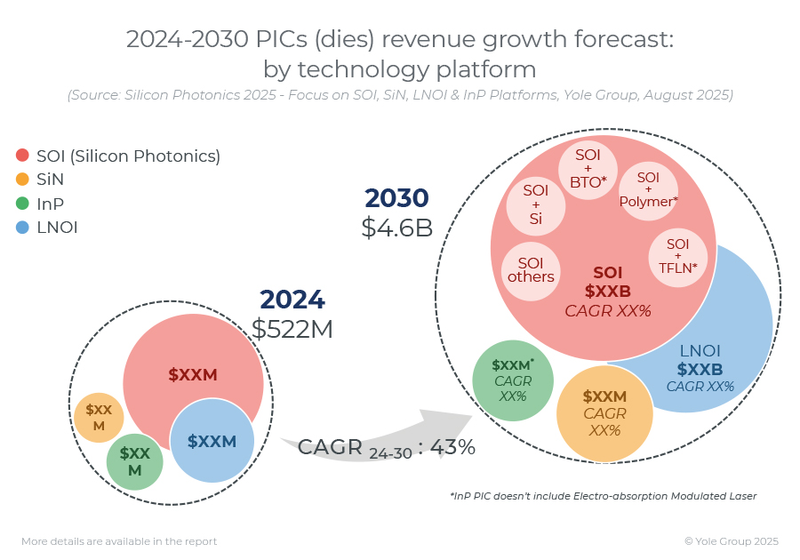
Recently, market research firm YOLE Group stated that silicon photonics technology is driving continuous breakthroughs in network bandwidth and helping to scale up AI networks. Its market size is expected to surge from $278 million in 2024 to $2.7 billion in 2030, with a projected compound annual growth rate of 46%.
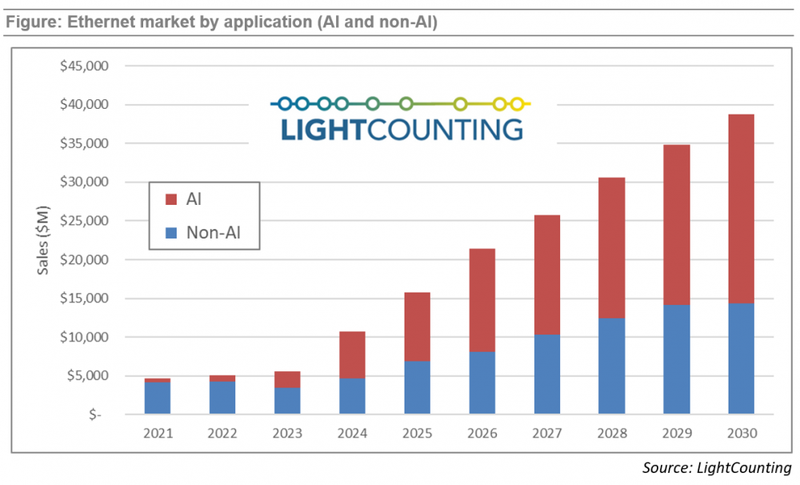
In the field of data centers, especially A1 and machine learning, traditional processor architectures are facing physical limitations, and the high-speed communication achieved by silicon photonics technology is crucial for supporting faster computing. The continuously growing bandwidth demand not only drives the advancement of silicon photonics technology, but also promotes the development of thin film lithium niobate technology, thereby enhancing network data transmission capabilities.
Photonic integrated circuits, especially silicon on insulator (SOI) and lithium niobate on insulator (LNOI), provide multifunctional platforms for large-scale and scalable applications, especially in the field of data centers, where Chinese companies are emerging as new leaders. With the stability of silicon material properties, the telecommunications industry has become another major application scenario.
In addition, optical LiDAR, 3D integration, quantum computing, optical gyroscopes, and even medical photonics all have enormous potential, although some applications still face technical and regulatory challenges. The extension of silicon photonics technology to the visible light spectrum may lead to more innovative applications in the future.
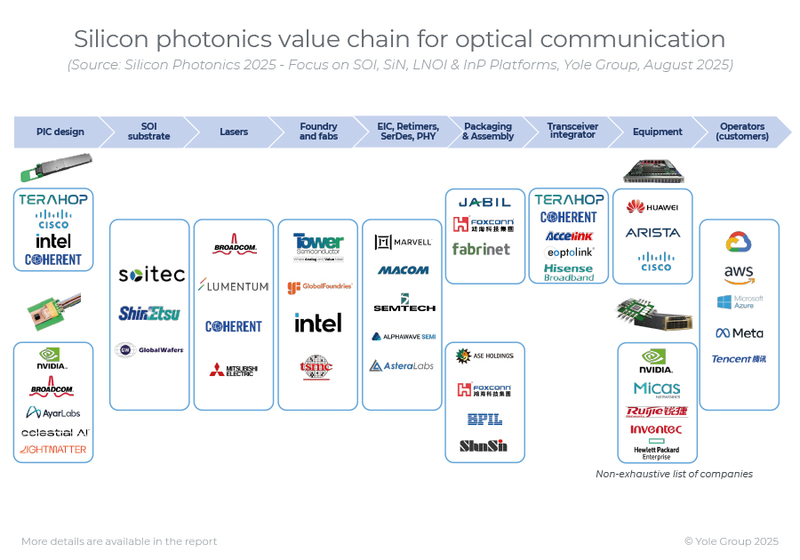
The industry holds an optimistic attitude towards the value that silicon photonics technology can create, and the industrial ecosystem presents a diversified pattern. Vertical integration giants such as Xuchuang Technology, Cisco, Marvel, Broadcom Lumentum、 New Yisheng actively lays out its layout.
Start up companies/design firms (Xphor, DustPhotonics, NewPhotonics, Openlight, POET Technologies)
Centera, AyarLabs, Lightmatter, Lightelligence, Nubis Communications continue to innovate.
Research institutions (University of California, Santa Barbara, Columbia University, Stanford Engineering School, Massachusetts Institute of Technology) provide technical support.
Contract manufacturers (Tower Semiconductor, GlobalFoundries, Intel, etc.) AMF、imec、 TSMC and CompoundTek ensure manufacturing capabilities.
Equipment suppliers (Applied Materials, ASML, Aixtron, FiconTEC, Mycronic Vanguard Automation)
Shincron aims to improve the industrial chain.
China has made significant progress in the field of silicon photonics and is committed to establishing a global leadership position. Chinese companies are focusing on independent innovation and improving their mass production capabilities for high-speed optical communication products, accelerating the narrowing of the gap with their Western counterparts, making China an important participant in this field.
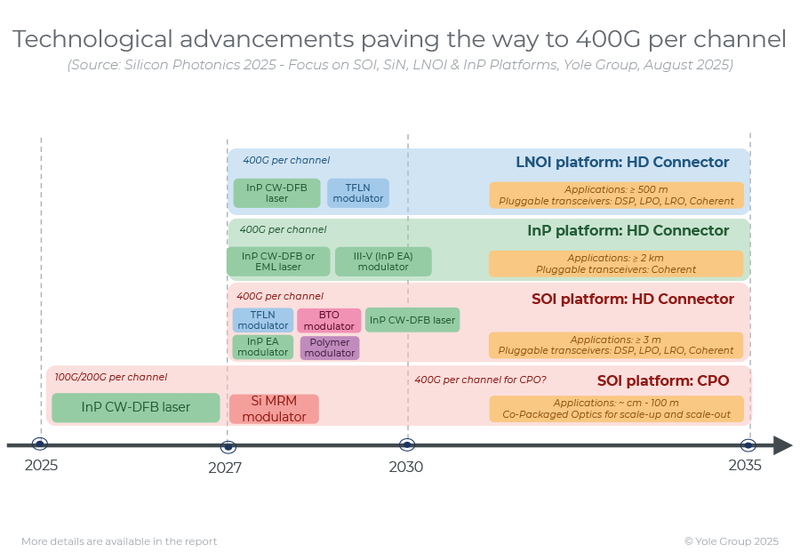
It is worth mentioning that higher single channel rates drive single port Ethernet speeds up to 3.2Tbps (or even higher), while achieving energy efficiency improvements and reducing the number of lasers. Reducing the number of lasers reduces capital expenditures, simplifies the supply chain, and reduces operating costs for heat dissipation and power supply. This development trend creates opportunities for the emergence of more technology platforms: based on the inherent properties of materials, LNOI and indium phosphide (InP) have become better choices for future high-speed connections.
The increasingly urgent need for scalable, energy-efficient, and cost-effective optical solutions in data center networks has given rise to SOI (TFLN, BTO, and polymer) The fierce competition between LNOI and InP platforms. Each platform has unique advantages and challenges, which will jointly shape the future of IM-DD or lightweight coherent pluggable modules and profoundly influence the development of the optical communication field.












 Record Number:鲁ICP备2022038891号-2