The China International Optoelectronics Summit Forum, held concurrently with the CIOE China Optoelectronics Expo from September 10th to 12th, was successfully held at the Shenzhen International Convention and Exhibition Center. As a multi-level international exchange platform integrating industry, academia, research, and application, this forum focuses on academic, industrial, and applied conference directions, comprehensively and deeply exploring the latest technologies and research directions in the field of optoelectronics.
During this period, Zhao Wenyu, Deputy Director of the Institute of Technology and Standards at the China Academy of Information and Communications Technology, delivered a keynote speech titled "Hotspots and Prospects of High speed Optical Interconnection Development in the AI Era", systematically interpreting the development logic, core breakthroughs, and future directions of optical interconnection technology under the demand for intelligent computing.
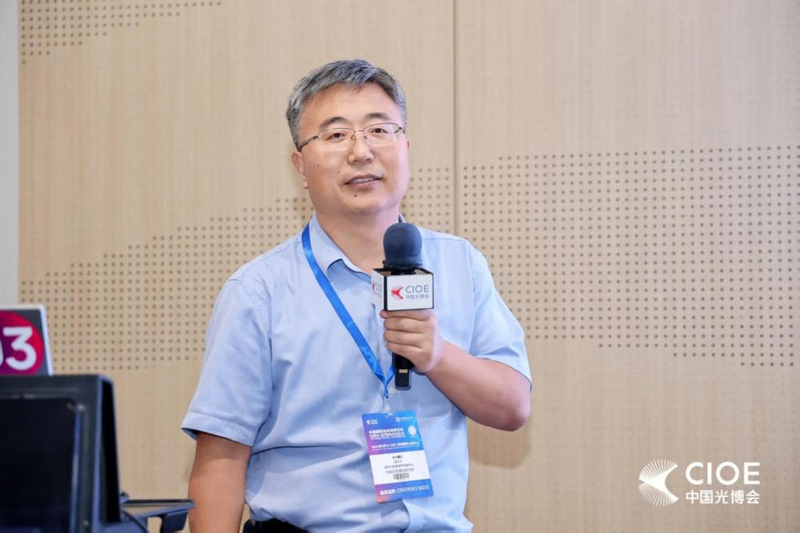
Optical/electrical interconnection is one of the core supporting links of intelligent computing infrastructure
At the beginning of the speech, Zhao Wenyu pointed out that the accelerated development of AI will intersect with the integration of information and communication technology, giving rise to new changes and explosive growth in computing power demand. In the past decade, the amount of computation required for training large language models has grown exponentially, with the growth rate of memory and interconnect bandwidth significantly lower than that of computing chips.
At the policy level, in recent years, China has introduced a series of policies to layout the rapid development of computing infrastructure. For example, in May 2025, the Ministry of Industry and Information Technology issued the "Action Plan for Computing Power Interconnection", proposing to promote new high-performance transmission protocols in facility interconnection by 2026 and improve the level of network interconnection between computing power nodes.
The emergence of equality models such as Deepseek has to some extent reduced the computing power demand for equivalent tasks, but in the longer term, it will not change the overall development trend of computing power demand. How to build a high-performance intelligent computing center network to support multidimensional applications has become a key point. ”He said.
It is worth noting that the optical/electrical interconnection mode has become a new focus of the game in the field of intelligent computing. Zhao Wenyu mentioned that it is expected that the global computing power scale will continue to grow at a rate of over 50% in the next five years. Based on optical or electrical interconnection, it is one of the core supporting links of intelligent computing infrastructure, and its higher speed, higher energy efficiency, higher integration, and higher intelligence have become typical development trends of optical interconnection.
The development trend of "four highs" in high-speed intelligent computing and optical interconnection
Next, he specifically introduced the development trend of the "four highs" of high-speed intelligent computing and optical interconnection, and sorted out the current innovation hotspots and practical progress of the industry.
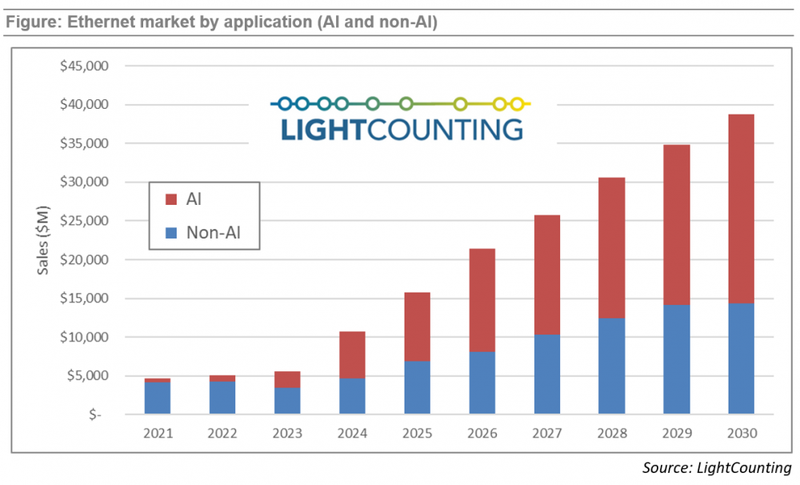
In terms of high speed, the 400G standard system is relatively complete, and a new multi-mode solution is proposed, which is expected to be released within this year. Driven by cloud applications, the Ethernet market is growing rapidly. Currently, 800G optical modules dominate in cloud data centers, and applications will gradually be launched within 1.6T years.
New high-speed technology solutions and samples are emerging, based on material platforms such as Chuan-V/silicon optics/thin film lithium niobate/PLZT. Multiple top single channel 200G/400G modulation technology solutions have been launched, and new samples with 1.6T/3.2T rates continue to emerge.
The long-distance coherent transmission interconnection rate continues to improve, the 400G technology system is basically complete, the trunk line is deployed on a large scale, the 800G/1.6T technology standard mining is accelerated, and pilot verification is launched.
In terms of high energy efficiency, the exploration of linear programming (LPO) technology and industrial applications is accelerating. The interconnection between server cabinets adopts optical method, and linear scheme is an optional way to reduce false energy consumption. The single channel rate is evolving from 100G to 200G. Single channel 100Gb/SLPO is in the initial application exploration stage, and compatibility and standardization issues need to be continuously verified. LRO has relatively better compatibility. At OFC2025, OIF conducted a demonstration of interoperability between LPO/LRO/DSP modules.
In terms of high energy efficiency, the exploration of linear programming (LPO) technology and industrial applications is accelerating. The interconnection between server cabinets adopts optical method, and linear scheme is an optional way to reduce false energy consumption. The single channel rate is evolving from 100G to 200G. Single channel 100Gb/SLPO is in the initial application exploration stage, and compatibility and standardization issues need to be continuously verified. LRO has relatively better compatibility. At OFC2025, OIF conducted a demonstration of interoperability between LPO/LRO/DSP modules.
The industry's attention to photonic composite sealing (CPO) solutions continues to increase. From the perspective of optical modules, integrating and packaging optoelectronic devices is another effective way to reduce energy consumption and latency in the face of cluster interconnection demands of 10000 or even 100000 cards. However, compared to the pluggable optical module mode, the overall industrial chain composition will undergo significant changes. The industry's attention continues to increase, and the basic ecology has begun to take shape. It is expected that CPO will be an important choice in the future development of ultra high speed optical modules. However, the development of CPO in China is relatively lagging behind, and there is a lack of intelligence and research in the industry. There are various technical solutions for CPO, and the comprehensive advantages of silicon optics are highlighted. Item.
It is expected that in the next 3-5 years, the market will experience a period of coexistence of re timed pluggable optical modules, LPO, and CPO. In the era of 800G and 1.6T, re timed pluggable will still dominate, and CPO and LPO may form a linear direct drive combined sealed version in the future. It is expected that CPO will gradually gain an advantage in 3.2T and higher speed rates. ”He said.
In addition, the optical in/out (OI0) for high-speed interconnection of computing memory will continue to evolve, and the industry will continue to explore lower energy OI0 solutions. Optoelectronic hybrid networking has become the preferred solution for achieving a ten thousand card cluster. The commercial use of the 0CS solution needs to be continuously promoted and evaluated, and the use of air fiber optic technology is expected to build high-capacity, low latency interconnected channels.
In terms of high integration, there are many participants in the silicon photonics market, including typical manufacturers such as Intel, Coherent, Xuchuang, SiFotonics, etc. China's basic process is relatively weak, and there is a lack of mass-produced silicon photonics process platforms, which has led to efforts from the industry to promote improvement.
In terms of high intelligence, AI empowers the end-to-end intelligence of optical network devices, mainly manifested in the gradual improvement of intelligence on the optical network device side. Currently, the standardization work of optical cable mute resources has been launched, and research on standardization of perception technology is actively carried out; At the same time, AI is assisting in the intelligentization of optical network control, and network assistants and intelligent agents have become the main forms of current large-scale model applications. Fault handling, dedicated line service opening, and dedicated line quality assurance have become high-value scenarios for the application of optical network intelligent agents. The construction of optical network intelligent agents and their evaluation standards has been preliminarily launched.
Zhao Wenyu introduced that on May 16th, during the World Telecommunication Day event, the China Academy of Information and Communications Technology successfully held a special seminar on "Full Optical Capacity · Millisecond Computing" in Nanchang, Jiangxi Province. Together with basic telecommunications enterprises, research institutions, industrial units, etc., the "Millisecond Computing in Urban Areas" action was launched to further promote the continuous improvement of the quality of computing network carrying capacity and accelerate the empowerment of artificial intelligence in new industrialization. In addition, he also introduced the recent progress of the International Organization for Standardization (IPEC) in high-speed optical interconnect technology and standardization work.
At the end of the speech, Zhao Wenyu stated that the many innovative businesses and application carrying demands triggered by artificial intelligence+can be expected to be applied in high-speed optical interconnection technology scenarios for intelligent computing applications. Under the guidance of national and local policies, we hope that the various entities of industry, academia, research, and application can work together to seize development opportunities, make up for shortcomings, and innovate. In the AI era, we will jointly promote the evolution of optical communication technology and industrial innovation, and empower the development of new quality productivity.










 Record Number:鲁ICP备2022038891号-2