At the 17th TOEM Forum held recently, industry veterans gave a keynote speech on the global trend of fiber optic cable development in an easy to understand manner. The focus of the global fiber optic cable market development is mainly on three directions: market demand, industry changes, and development trends. market demand
Looking at the current global demand sources for fiber optic cables, they are mainly distributed in the following categories: FTTH (Fiber to the Home), 5G base station construction, AI computing center construction, long-distance transportation, and submarine cables.
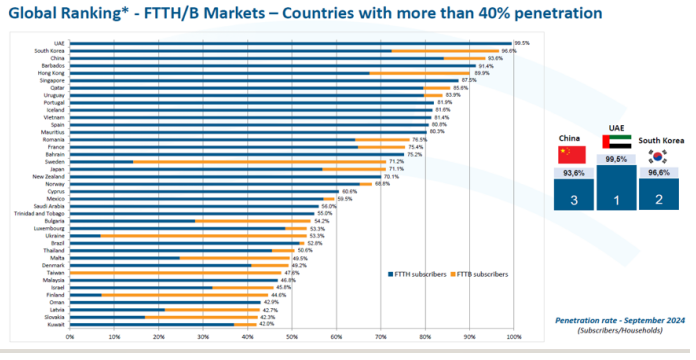
According to a statistical data, as of September 2024, the top three countries in terms of fiber to the home penetration rate globally are the United Arab Emirates (99.5%), South Korea (96.6%), and China (93.6%). The top two countries have a smaller area and a more developed economy, resulting in a higher penetration rate of FTTH; However, despite its vast territory, China has the third highest FTTH penetration rate in the world, thanks to the rapid development of its communication infrastructure in recent years. Of course, the current overcapacity and sluggish market in the domestic fiber optic cable market are also closely related to this. However, it can also be seen that the penetration rate of FTTH in many developed countries in North America and Europe is not high, and many countries near China in Southeast Asia are the same. This means that when these countries and regions carry out FTTH infrastructure construction in the future, the demand for their fiber optic cable products will be considerable.
In terms of 5G base station construction, according to Deepseek query data, as of June 2024, the total deployment of 5G base stations worldwide reached 5.94 million, a year-on-year increase of 32.6%. Among them, China has 3.917 million 5G base stations, accounting for 66% of the global total. From the bidding of Chinese operators, it can be seen that the demand for 5G base stations, led by China Mobile, is decreasing year by year, and the period of rapid construction in China has passed; In contrast, the construction of 5G base stations abroad has enormous growth potential.
The demand for the construction of AI computing power centers and big data centers is constantly increasing. The AI big model is a popular project nowadays, which cannot be separated from the computing power support of data centers. Data shows that the investment and construction scale of overseas computing power centers is nearly 300 billion US dollars; China has an investment and construction scale of nearly 400 billion yuan. As a comparison, China Mobile's annual investment budget (capital expenditure plan) for 2025 is about 151.2 billion yuan, indicating that the investment in A! And data centers has exceeded the investment of operators. This includes a large demand for indoor optical cables, including, MPO8, Requirements for 16 core jumpers (OM3, OM4, OM5 optical fibers) and ultra high core optical cables (1768 cores indoor/outdoor).
Industrial changes
The main countries and regions for the current production of fiber optic preforms are the United States (Corning and Lightera), Europe (Prysmian), Japan (Lightera, Fujikura, Sumitomo), and China (Changfei, FiberHome, Hengtong, Zhongtian). In the past two years, there have been certain changes among leading global fiber optic cable companies: the discontinuation of Heraeus quartz tubes, the withdrawal of Xinyue prefabricated rods from the Chinese market, the financial crisis of Futong Group, and the closure of Prysmian's Italian factory. At the same time, the price of single-mode optical fiber has been continuously declining in the past two years, which is also the reason for the industrial changes of some prefabricated rod enterprises - the decrease in optical fiber prices has made it more difficult to control the cost of prefabricated rod drawing
In addition, there is a significant characteristic in China's fiber optic cable market: unlike foreign fiber optic giants that rely on sales to determine production, domestic enterprises still rely on production to determine sales, which will lead to further price declines among enterprises due to competition for orders during the market demand platform period.
development trend
Looking at the world, the current fiber optic cable market is showing the same development trend: new fiber optic products are constantly emerging, such as multi-core fibers, hollow fibers, G.654. E, etc. The research and development direction of these products is generally aimed at achieving lower attenuation, larger effective area, lower dispersion, smaller nonlinearity, and lower latency to serve the increasingly high standard demands of the current communication market. From the bidding and on-site testing of domestic operators alone, it can be intuitively seen that more and more new products are moving from concepts and test products to large-scale commercial use.
In summary, as the domestic fiber optic cable market enters a plateau period, overseas expansion and research and development of new products are the directions for enterprise development. The global fiber optic cable market landscape is also constantly changing, and seizing the technological high ground and taking the lead in layout is the necessary path to "break through".












 Record Number:鲁ICP备2022038891号-2