On June 3rd, LightCounting, a research institution in the optical communication industry, recently stated that although silicon light has many advantages, it took nearly a decade for it to have an impact on the optical module market. The decisions of several major companies such as Cisco, Huawei, and Intel have accelerated the deployment and application of silicon photonics.
LightCounting predicts that the application of LPO and CPO will double the market share of silicon photonics from 30% in 2025 to 60% in 2030. Several major companies such as Broadcom and Nvidia will become drivers of this transformation.
Nvidia is prioritizing the use of silicon optical technology for current and next-generation optical systems. In March 2025, Nvidia announced the launch of the world's first 1.6T CPO system using a new micro ring modulator. Nvidia announced that its Quantum-X silicon optical switch will be shipped in the second half of 2025, while the Spectrum-X system will follow suit in the second half of 2026.

The transition from pluggable optical modules to CPO is exciting for the entire industry, but setting reasonable expectations to drive the adoption of these solutions is crucial. In addition to manufacturing challenges and meeting lower power consumption targets, end users must also accept CPO as a viable solution for continuously reducing costs.
Meta and Microsoft advocate for the establishment of a new ecosystem around CPO and the development of industry standards for optical engine manufacturing, but initial products will still be based on proprietary designs. This is a major obstacle to large-scale deployment for large clients who tend to design their own servers, switches, and all interconnected devices.
To accelerate deployment, Nvidia can provide end users with a complete system integrated with CPO, fully responsible for the operation and maintenance of the system. If such systems can bring significant performance improvements, customers will be willing to accept them. However, relying solely on Nvidia's design is not an acceptable long-term strategy for Meta, Microsoft, and other large cloud companies. To support the large-scale deployment of CPO, a new competitive ecosystem is needed.
LightCounting expects that most CPO deployments will be used for scale up interconnection. Nvidia has not officially announced such a solution yet, and the company plans to use copper interconnects in Rubin and Rubin Ultra scale up networks within a single 600 kW rack. The organization believes that a multi rack scale up system will require CPO, and even if CPO is moderately adopted in a scale up network, it will require millions of ports because its bandwidth requirements are 9% of those of a scale out network
retainer
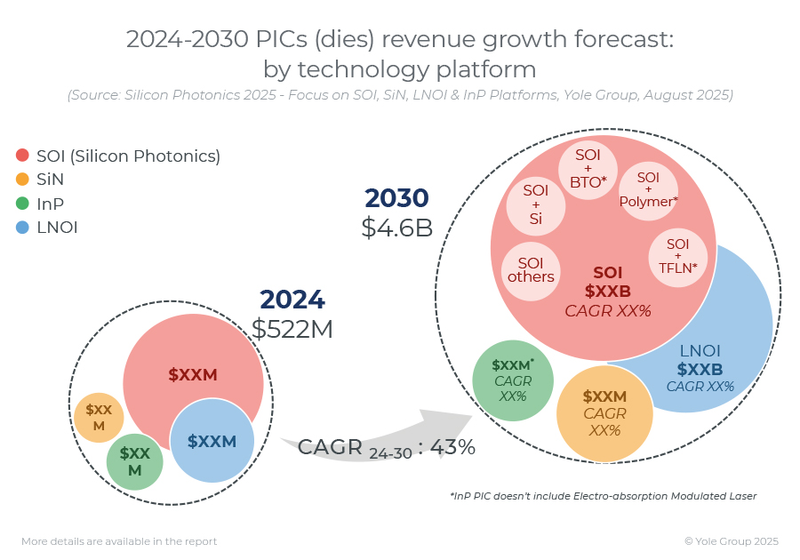
The report also estimated the market value of optical chips used in optical modules, AOC, LPO, and CPO shipped in 2024 to be approximately $1.7 billion, with silicon optical chips accounting for about one-third. Although the market size is relatively small, all leading CMOS foundries such as TSMC, STMicroelectronics, SilTerra, etc. are entering or returning to this market.
LightCounting states that the size of the optical chip market is expected to double and exceed $5 billion by 2030. The market share of silicon optical chips is expected to double, which means a 6-fold growth. Although the predicted market value is slightly considerable, it is still insufficient for companies such as TSMC.
Therefore, attracting CMOS foundries to invest in silicon photonics technology is inevitably a long-term strategic consideration. Similar to Intel's vision over the past two decades: optical interconnect (such as CPO) will become an essential technology for the proper functioning of any complex ASIC. Now it seems that this vision may only take ten years to achieve, and it is the best time to focus on silicon-based technology.
Intel may have been ahead for a full twenty years, but now, neither large CMOS foundries nor ASIC manufacturers can afford to miss this opportunity. At the time of this report's release, AMD has acquired Enosami to accelerate the development of CPO technology for AI systems.













 Record Number:鲁ICP备2022038891号-2