On January 17th, it was announced that the era of AI has arrived. The emerging AI applications such as large-scale models require massive computing power support, and intelligent computing centers have sprung up one after another. Large scale 10000 card clusters are gradually being put into commercial use. How to better realize the interconnection of intelligent computing centers and serve the innovative development of A! Applications has been extensively researched in the industry.
On January 16th, as the opening work of the "2025 China Optical Communication High Quality Development Forum", the online seminar on "Intelligent Computing Center Interconnection: Computing Network Collaboration, Building a New Base for Intelligent Computing Interconnection" was successfully held.

At the meeting, Zhang Hai, Director of the Institute of Technology and Standards at the China Academy of Information and Communications Technology (referred to as the Institute of Standards at the China Academy of Information and Communications Technology), pointed out in his speech that currently, China's regulatory authorities continue to release policies related to computing infrastructure, guiding the high-quality development of computing infrastructure. AI big models and related applications are driving the development of intelligent computing centers towards clusters with over 10000 cards or more. High quality interconnection related technologies such as interconnection within intelligent computing centers, interconnection between intelligent computing centers, and support for intelligent computing applications have become hot topics of concern. Next, she introduced the specific situation of the development of corresponding key technologies.
Interconnection within the Intelligent Computing Center
Zhang Haiyi pointed out that the interconnection within the intelligent computing center needs to support large-scale model training with parameters of trillions or more, while also meeting the requirements of ultra large scale networking
Requirements for high bandwidth, ultra-low latency, and high availability.
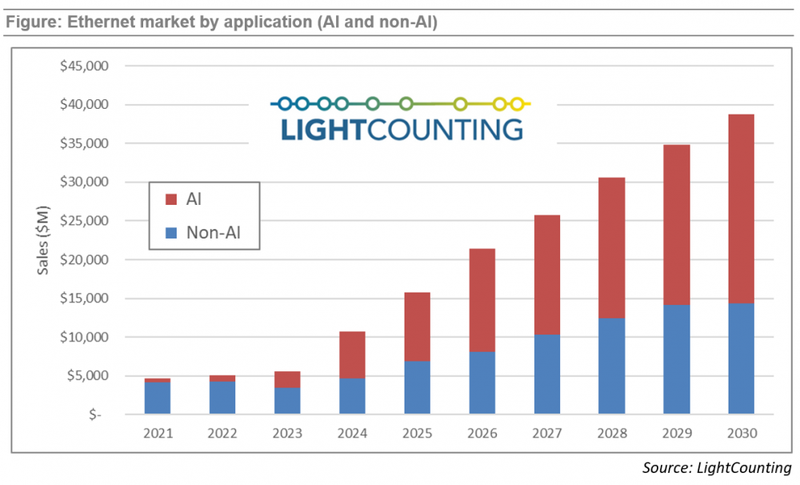
At present, the interconnection related protocols and technologies within the intelligent computing center are competing for development, and the open and dedicated modes of inter chip interconnection continue to compete. The internal networking of the intelligent computing center is developed through the coexistence of IB and various Ethernet based solutions. The former wins with performance, while the latter, due to its openness and cost-effectiveness, is further increasing in the proportion of A! Large model training networking.
Large scale AI training requires efficient collaborative computing center software and hardware resources, and a fast, efficient, and portable communication library has become an important factor affecting the efficiency of intelligent computing. At present, top domestic and foreign manufacturers mainly focus on developing their own unique high-speed integrated communication libraries, bundled with specific chips as a whole. To further efficiently support the deployment and application of intelligent computing, heterogeneous compatibility of communication libraries may become a future trend.
Meanwhile, the demand for high bandwidth is driving the acceleration of high-speed optical module iteration. The speed of the direct adjustment and detection optical module in the data center is expected to be updated every 3-4 years. After the introduction of AI intelligent computing, the iteration cycle has shown a trend of shortening. Currently, the main stage is beyond 800Gb/s speed, and it is expected to enter 1.6Tb/s speed in the next 1-2 years. By 2030, 3.2Tb/s speed will be applied on a large scale. Driven by AI applications, the demand for high-speed optical module applications continues to be strong, and the standardization layout at home and abroad is accelerating towards T+level evolution and extension. At the same time, in order to ensure the quality of interconnection, the intelligent computing center may put forward higher requirements for indicators such as optical module bit error rate,
In the face of application requirements such as low energy consumption and low latency, linear driver pluggable modules (LPO) and their applications continue to be researched and explored. The interconnection between server cabinets adopts optical methods, and the single channel rate is evolving from 112G to 224G. Linear solutions are an effective way to reduce energy consumption. Currently, the application of 112G/aneLPO is in the exploratory stage, and compatibility and standardization issues need to be continuously studied and evaluated. 224G/lane LPO is expected to be demonstrated for interoperability in 2025. Considering the balance between performance and energy consumption, it is expected that the 224G/ane pluggable solution will tend to linearly receive pluggable optical modules (LRO), which is more likely.
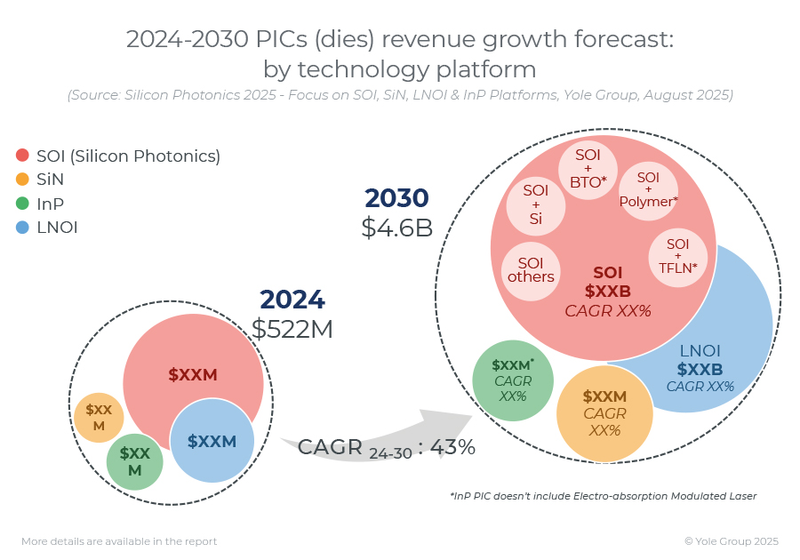
In addition, chip level optical interconnection provides a new solution for high-density and low-energy interconnection. Chip level optical interconnection has many advantages over electrical interconnection or traditional pluggable module interconnection, such as large bandwidth, low energy consumption, and high integration. In inter chip optical interconnection, CPO is mainly used for switching networks, while OI0 is mainly used for computing and storage networks. The recent development of AI clusters has driven the rapid rise of OI0 popularity. At present, the world's leading silicon optical platform relies on its strong chip processing and manufacturing capabilities and advanced packaging capabilities to continuously make new breakthroughs in chip level optical interconnection
In addition, from the current development situation, intelligent computing and optical interconnection empower each other in both directions, and the role of optical interconnection is becoming increasingly prominent. The trend of light entering and leaving copper continues, but short-range electrical interconnection still has strong vitality due to its high reliability and low cost. In addition, considering the training and inference requirements of large models such as energy consumption, flexibility, and reliability, the all-optical switching network and connection reliability within the intelligent computing center have become a continuous focus of attention in the industry.
Interconnection between intelligent computing centers
The typical requirements for interconnection between intelligent computing centers are long-distance, high throughput, and efficient collaboration between computing centers. It is necessary to support the construction of distributed intelligent computing clusters through long-distance lossless and extremely low failure rate interconnection capabilities. The current development situation is as follows:
The demand for high bandwidth, low latency, and high reliability is highlighted. Multi cluster distributed training for intelligent computing is expected, and the business requirements for inter computing interconnection include interconnection between multiple intelligent computing centers with similar distances, interconnection between large-scale hub computing power nodes, and interconnection and collaboration between edge and core clouds to achieve distributed training, training inference collaboration, data handling, and other scenarios. At the same time, various applications require high-quality interconnection, including the interconnection of teaching data centers between large-scale hub computing power nodes, interconnection between multiple data centers in close physical locations, and collaboration between edge and core data centers.
The second is to accelerate the exploration of intelligent computing distributed training application experiments. At present, many companies have carried out intelligent computing distributed training experiments/trials, but distributed applications still face multiple technical challenges, such as wide area network performance requirements, operation and control complexity, and network construction costs, which are all limiting factors. It is necessary to continuously promote technological innovation in multi-layer, multi domain, single point technology breakthroughs, cross layer, cross domain, and multi technology collaborative integration,
The third is the launch of 400G scale deployment for trunk lines, and the gradual trial of 800G+in urban areas. At present, the 400G technology system is basically complete, and Chinese operators are gradually starting to deploy mainline scenarios. The WSS and OTU in the 400G system have achieved integrated design in the C+L band, but the integrated OA technology solution is still being explored and verified. For higher speed transmission technologies, the industry is accelerating the development of 800G/1.6T technical standards. Standardization organizations such as OIF and ITU are conducting related project research work, and the industry has also launched pilot verification.
The fourth is the acceleration of new optical fibers to help build high-quality networks. On the one hand, G.654. E and other ultra-low loss optical fibers have become the optimal choice for interconnection applications between intelligent computing centers, suitable for applications such as 400G and above ultra high speed long-distance, C+L multi band large capacity, etc., supporting high-quality interconnection needs and being the key to improving network transmission performance; On the other hand, hollow core optical fibers have many advantages and promising development potential. Currently, there are still many challenges that need to be overcome, such as preparation processes and engineering deployment. In the future, the industry still needs to continue to strengthen collaboration and help forge future ultra-low latency computing power networks.
Intelligent computing application support
In terms of intelligent computing business support, it mainly includes functions such as data entry and end-to-end collaborative control. All-optical access provides users with flexible quality accounting, mainly including 10G all-optical accounting for home parks, convenient one-stop accounting for small and medium-sized enterprises, and high-quality dedicated line accounting for large enterprises. At the same time, end-to-end collaborative control is used to assist users in quickly entering the cloud and computing. On the access side, further enhance user perception capabilities;
Realize intelligent control based on intent on the interconnection side of data centers; On the data center network side, achieve collaboration between the entire data center network and data center interconnection. Overall, the scheduling of user input and intelligent computing training requires collaborative control between the computing network, taking into account multiple factors such as users, networking, and computing power providers. Under the constraints of task requirements and computing network resources, multi-level devices are flexibly and uniformly scheduled to dynamically establish connections between users and computing power services as needed.
In addition, the network big model has become a key technology for network intelligence to move towards L4, and it is even more advanced. Operators and device/software vendors are laying out large-scale network models, utilizing their efficient understanding and generation capabilities to enhance network self intelligence and accelerate the advancement of intelligent computing network self intelligence towards high-level self intelligence L4
Finally, Zhang Haiyi stated that the Standards Institute of China Academy of Information and Communications Technology will continue to carry out work related to the development of intelligent computing center interconnection technology industries, monitoring of computing power network performance, and the 1ms urban action plan for computing power access. She hopes to work together with the industry to build a new ecosystem for innovative development of China's intelligent computing and interconnection network technology industry, and help promote the high-quality development of China's optical communication industry.











 Record Number:鲁ICP备2022038891号-2