On the afternoon of October 19, the 2026 Global Fiber Optic Cable Conference opened today at China's Optics Valley in Wuhan. Mao Qian Chairman of the APC Conference, full-time standing committee member of the Communication Technology Committee of the Ministry of Industry and Information Technology, and Chairman of the Asia-Pacific Optical Communication, stated while releasing the "2026 Global Fiber Optic Cable Industry Development Report" that over the past 20 years, the prosperity of the fiber optic cable has completely fluctuated in line with the capital expenditure cycles of telecommunications operators. From 2019 to 2023, it experienced the longest adjustment cycle with centralized procurement prices dropping from over 60 yuan per kilometer per core to less than 20 yuan, and the industry even saw the saying that "fiber is cheaper than noodles.", in 2026, this logical chain was completely broken. Fiber has gradually become a bottleneck component in the delivery of computing power infrastructure, with pricing power systematically shifting buyers to sellers, and the industry moving from low-price cutthroat competition to a return to value. He summarized this change in eight words: "Emerging from the trough computing power pricing."
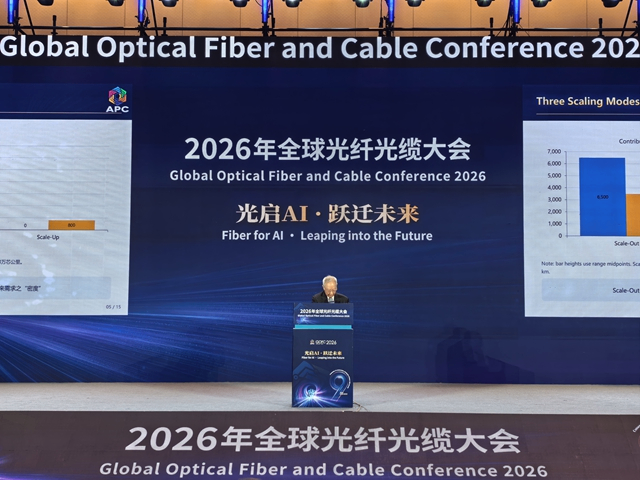
First, looking at the demand side, the decision-making power for fiber demand has shifted from telecommunications operators to cloud service providers, changing from plandriven to competition-driven, with volatility decreasing and rigidity increasing. The deeper implication of this shift is that traditional telecommunications demand is driven by operators' coverage strategies, with procurement plans and coverage-centric KPIs; in contrast, AI computing power demand is driven by cloud providers' strategic deployment plans, representing an arms race among tech giants. Construction progress determined by GPU supply, power supply, and land grades, and fiber prices have no decisive impact on construction decisions. This means that even if the growth rate of AI capital expenditure slows down after 2028, the absolute level of fiber demand will not return to pre-2024 levels, because the proportion of AI data centers in total has systematically increased. Data confirms this judgment: in 2026, the total global demand for fiber optic cables is about 630 million core-kilometers a year-on-year increase of about 10%; in the North American market, the proportion of AI data centers in fiber demand has jumped from less than 3% in 2025 to over 70%.
Why is the consumption density of fiber in AI data centers higher than in traditional data centers? Mao Qian proposed triple overlapping mechanism. First, a fundamental change in network architecture: traditional data centers use a three-tier aggregation model where the number of fiber connections grows linearly with the number of, whereas AI data centers have fully shifted to an all-to-all interconnected architecture, requiring high-frequency, low-latency communication between GPUs, which drastically increases the number fiber connections. Second, the number of connections grows quadratically with the number of GPUs: N GPUs theoretically require N*(N-1)/2 connection paths. From 1,000 to 100,000 GPUs, fiber usage could increase dozens of times, and the number of fibers required for an NVIDIA Blackwell GPU node is16 times that of a traditional cloud switch. Third, the iteration of optical module speeds brings a dual amplification of both volume and price: 400G requires to 8 single-port connections, 800G requires 8 to 16, and 1.6T requires 16 or more. The growth optical module shipments combined with the increased precision per port creates a cumulative effect.
The drivers of North American demand vary in focus. According to analysis, Scale-Up is the current main force, with North America accounting for about 60 to 0 million fiber-kilometers in 2026, contributing the vast majority of current North American AI fiber demand, and an expected addition of 30 to 0 million fiber-kilometers in 2027; Scale-Across has high single-link value, using G654.E ultra-low-loss fiber with about 800,000 to 1.2 million fiber-kilometers in North America, limited in total volume but with the strongest profit resilience; ScaleOut will launch in 2027 with the fastest growth rate, expected to reach 6 to 10 million fiber-kilometers in North America, though it drop to 3 to 6 million if OIO technology is delayed. These three will gain momentum sequentially, supporting the continuous growth of North American fiber demand. "In a nutshell Scale-Up determines the quantity of demand, Scale-Across determines the quality of demand, and Scale-Out determines the density of future demand."
Demand is so robust, yet cannot keep up. Mao Qian judged that the physical rigidity formed by the expansion cycle of optical fiber preforms determines the continued supply tightness in the global fiber market from 206 to 2027, a constraint that cannot be quickly alleviated by price because the production line construction cycle is rigid. The industry's most core bottleneck lies in fiber preforms, which account for about 71% of fiber production costs; a 3,500-ton preform factory requires an investment of about billion RMB, with a construction cycle of 18 to 24 months. In 2026, the production capacity of leading global preform manufacturers will generally at full load, with the effective capacity utilization rate of Chinese preforms at 84.3% and North American Corning factories exceeding 95%. The global nominal supply 995 million fiber-kilometers far exceeds the demand of 630 million fiber-kilometers, but nominal supply does not equal effective supply. Some capacity cannot the demand of AI data centers for G657.A2, G654.E, and polarization-maintaining fibers, trade barriers will isolate some capacity the North American market, and the preform bottleneck limits the release of fiber drawing capacity. Comprehensive estimates show the effective supply is only 480 to 520 fiber-kilometers, with a supply-demand gap of about 110 to 150 million fiber-kilometers.
The essence of this gap is structural mismatch. The global total demand for G657.A2 fiber in 2026 is about 370 million fiber-kilometers, with an capacity of only 200 to 210 million fiber-kilometers, a gap rate as high as 46%; the gap for polarization-maintaining fiber about 8 times. The North American market is particularly prominent, with a local nominal capacity of about 135 million fiber-kilometers and an actual deliverable capacity 120 to 130 million fiber-kilometers. Corning's new factory will ramp up at the earliest by the end of 2027 the first project of Prysmian's acquisition of US capacity will be implemented in 2028, and Fujikura will not be able to contribute supply until 028, meaning there is almost no incremental local fiber capacity in North America from 2026 to 2027. Although overseas giants have invested over0 billion US dollars in expansion and major domestic enterprises are also expanding intensively, constrained by the 18 to 24-month expansion cycle, global preform capacity is to grow by about 10,000 to 15,000 tons from 2027 to 2028, with large- capacity release concentrated between the end of 2027 and 2028. Therefore, the situation of supply shortage in 2027 still cannot be improved.
Supply-demand gaps inevitably transmit to prices. Mao Qian pointed out that the overlay of three-layer drivers—product structure switching, supply-demand gap premiums, and increased-added from costs—has driven a historic reset of optical fiber prices, shifting the industry from low-price competition to value competition. The price of China's G62.D bare optical fiber climbed from 32.25 yuan per kilometer in January to 95.78 yuan in June, an increase of about 17%; G657.A2 rose by about 161%, and G654.E by about 126%. North American G67.A2 prices reached 21 to 25 USD per core-kilometer, 2 to 3 times the global benchmark. The first driver is the product switch, as the market shifts from primarily procuring G652.D to procuring G657.A2, G654.E, and other data center fibers, with completely different costs and pricing; the second is the supply-demand gap premium, with a 46% gap rate for G657.A2 an even larger gap for polarization-maintaining fiber, leading to price increases far exceeding those of ordinary products; the third is the increased value-added of optical cable and connection, where the comprehensive unit price of optical cables is typically 2 to 3 times that of bare optical fiber, and the price hike of bare optical fiber is transmitting to costs connection solutions, shifting the industry chain's value from selling optical fiber to selling optical cables plus connection solutions.
Data on profit recovery further illustrates the issue. From 221 to 2026, the sales revenue of major global companies is projected to grow from 66.55 billion yuan to 78.29 yuan, with a compound annual growth rate of about 3.3%; net profit is expected to grow from 5.53 billion yuan to 12.6 billion yuan, with a compound annual growth rate of about 27.5%; the net profit margin is projected to rise from 8.31% to 2.79%, with the profit growth rate being more than 8 times the revenue growth rate. Mao Qian said this indicates that the industry's growth momentum comes from price and product structure upgrades, and the industry has already shifted from low-price competition to value competition, and from scale-oriented to profit-oriented.
From "optical fiber than noodles" to a bottleneck component of computing power infrastructure, the optical fiber and cable industry has completed a revaluation of its identity in a few years. Mao Qian's reminds the industry that this round of prosperity is not a simple cyclical rebound, but the result of simultaneous shifts in demand subjects, supply constraints, and pricing logic. As optical fiber from a supporting material for telecommunications networks into a critical delivery link for computing power infrastructure, the questions the industry must answer are no longer just about expanding production and raising prices, how to safeguard value amidst structural mismatches and maintain rationality within physical rigidities. After emerging from the trough, whether computing power pricing can be converted into the ability to traverse cycles be the true test of this industrial leap.











 Record Number:鲁ICP备2022038891号-2