October 26 News: Recently, Credo held its annual media conference. The company's executive team introduced the latest progress in optical DSP, silicon photonics (Pho), and system-level interconnect solutions, and elaborated on the strategic logic of building "electrical-optical-system" full-stack capabilities through continuous acquisitions.
The Rise Supernode Formats: A Structural Shift in AI Interconnect Demand
Yang Xuexian, Vice President of Sales for Credo China, pointed out in the opening that the focus has fundamentally shifted over the past 12 months. The improvement of single GPU computing power is no longer the main bottleneck; instead, it has been replaced by the scale of GPU interconnect supernodes—from the 32-card and 64-card configurations discussed last year, to the 512-card and 104-card configurations that have now become the norm.
The growth rate of interconnect demand in AI factories far exceeds the performance improvement of GPUs themselves, meaning that larger-scale higher-reliability network interconnection has become the first-principle proposition in AI infrastructure construction.
This trend is directly reflected in Credo's performance. The company's quarterly revenue reached $479 million, maintaining triple-digit year-on-year growth for seven consecutive quarters; revenue for fiscal year 2026 exceeded $.3 billion, while Wall Street's expectations for the new fiscal year have been raised to approximately $2.5 billion. Yang Xuexian specifically compared the growth structures major industry competitors—a significant portion of their incremental growth comes from the ASIC business, whereas in the pure interconnect product field, Credo's growth rate is significantly leading, its market share continues to expand. This data difference indicates to some extent that AI customers are shifting the choice of interconnect solutions toward specialized suppliers.
Complete DSP Technology Generations: Delivering the Best Performance-Power-Cost Combination to Customers
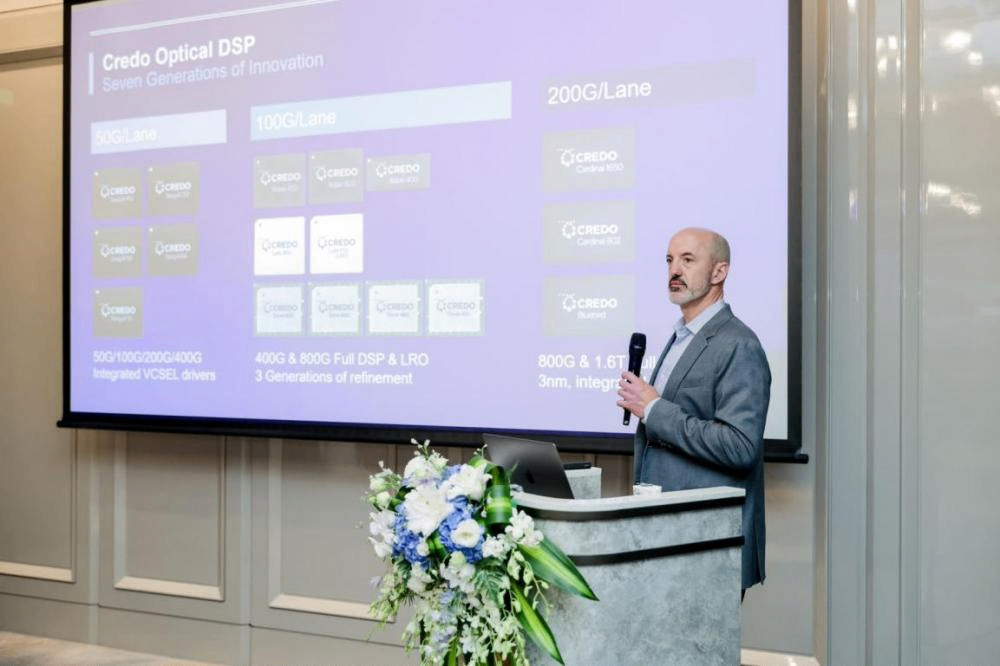
As the company's star product, Chris Collins, Vice President of Sales and Optical Product at Credo, systematically reviewed the evolution of the optical DSP product line. From its founding in 2008 focusing on SerDes IP, to the debut of its chip in 2016, and now boasting 7 generations of products covering 50G/100G/200G per-channel rates,o has accumulated a relatively complete technological lineage in the high-speed interconnect field.
For 100G products, Credo made a noteworthy choice. Facing the industry of 5nm wafer capacity being fully booked and prices continuously rising, Credo migrated the originally 5nm Lark DSP to a 7nm process, launching the Robin series The new solution integrates a laser driver while maintaining the same power and performance metrics, further reducing the package size. This directly addressed the risk of project delays for customers caused by capacity, becoming a key factor in the Robin series gaining market recognition.
For 200G products, Credo adopted an architectural strategy different from its competitors. Competitors launch 8-channel single-chip solutions for 1.6T modules, but this approach has cost and power efficiency disadvantages in 800G applications. Cred, on the other hand, introduced the 4-channel Cardinal 802 DSP, which can be used in pairs for 1.6T or as a single for 800G, making it particularly suitable for the typical topology of a 100T switch downlinking two 800G modules connected to NVIDIA Connect-9 network cards. Additionally, Credo provides two dedicated DSPs, 8-channel and 4-channel, for the LRO market to meet the needs of system architectures with lower power consumption and less latency. Chris Collins revealed that Credo has completed 448G (single-wavelength 400G) die testing the lab, building a technological foundation for next-generation rates.
Building a Complete Electro-Optical Solution: Adapting to Different Customer Design Preferences
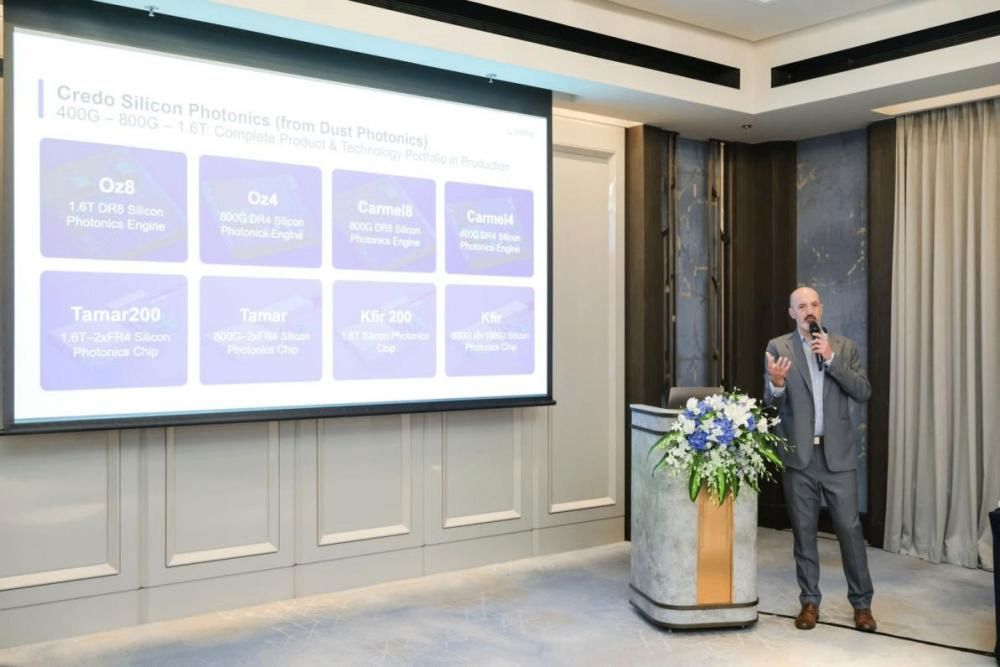
In May 2026, Credo completed the acquisition of DustPhotonics, move viewed internally as a key milestone in extending from "electrical interconnects" to "optical interconnects." Through this acquisition, Credo obtained a complete technology platform for silicon photon PICs, with its product line divided into two categories: light engines with integrated light sources and standard silicon photonics chips containing only modulators, catering to different customer design preferences.
The technical core of Credo's silicon photonics lies in ultra-low-loss laser coupling. This technology allows customers to directly use off-the-shelf lasers achieve 2 lasers lighting up 8 channels with extremely low coupling loss, such as 800G DR4, thereby reducing the number of lasers used and lowering power and material costs. This solution is also applicable to NPO and CPO scenarios.
However, owning both electrical and optical chips does not automatically create an advantage. Chris Collins out that Credo's true value lies in the pre-joint optimization of the interface between the DSP and silicon photonics—including impedance matching, driving capability, thermal management and firmware telemetry. When customers purchase the complete solution, they do not need to debug the optoelectronic interface themselves, saving months of engineering cycles. At the supply chain level,o can allocate DSP capacity and silicon photonics capacity across multiple process nodes, improving delivery certainty.
On system-level products, Credo has extended this integration capability to AEC electrical cables and ZeroFlap optical modules. ZeroFlap technology, through special IP built into the DSP, monitors the health status of optical and electrical links in real time, issues before link degradation, and records complete contextual information after a failure occurs. Credo claims this solution can improve interconnect reliability by two to three orders of magnitude. In March 226, the 800G ZeroFlap optical module was officially launched. In addition, Yang Xuexian also introduced Credo's new exploration in the direction the "memory wall"—using high-density SerDes IP to design adapter chips, enabling GPUs to connect to LPDDR memory, achieving bandwidth close to HBM while gaining times the capacity, which is particularly suitable for inference scenarios.
**Doubling Down on China: 400G per Lane Named Next-Generation R&D Target**
During the Q&A session, Phil Komen, Senior Vice President of Global Sales at Credo, said the company is actively expanding to meet market demand over the next five to eight years. Credo now employs more than 1,000 people worldwide, with roughly half based in Greater China, where it maintains multiple offices including Shanghai, Wuhan, Nanjing, Hong Kong and Taiwan. In its optical DSP business, Chinese partners currently contribute the majority of revenue; and in product lines targeting domestic GPU vendors, the Chinese market is also seen as a core growth engine.
According to industry data, seven of the world's top ten optical module manufacturers are Chinese companies, and all of them have announced product upgrades and capacity expansion plans—setting the stage for the adoption of Credo's solution portfolio.
Addressing the widely debated question of an AI bubble, Komen responded that judging whether a bubble exists is no easy task, but noted that Credo's customers have generally signed long-term orders spanning more than two years, with some securing five-to-seven-year contract arrangements on land, power and GPU procurement. Given the company's capacity planning and headcount expansion, it remains confident in the continued growth of interconnect demand.
On the technology roadmap, Credo has clearly established 400G per lane as its next-generation R&D target, and plans to advance DSP and silicon photonics platform iterations in parallel, ensuring it can deliver complete, jointly optimized solutions when customers need them. This "electrical-optical-system" full-stack capability may well become the cornerstone of Credo's differentiation in an increasingly crowded high-speed interconnect market.












 Record Number:鲁ICP备2022038891号-2