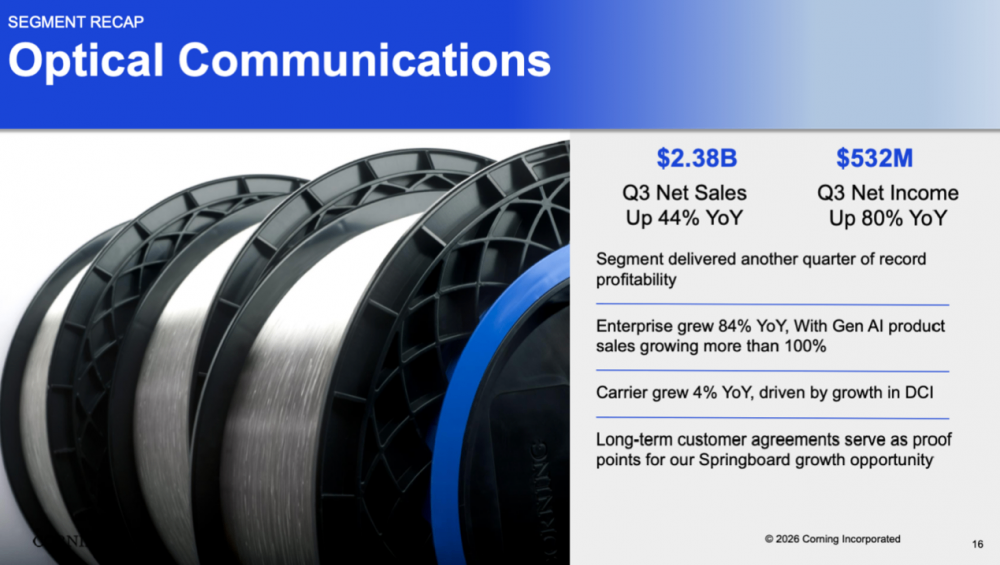
October 28 news: Recently, Corning announced its third-quarter results for 2026. During the period, Corning's core sales increased by 19% year-on-year, reaching $5.08 billion.
The optical communications business achieved sales of $2.38 billion in the third quarter, up 44% year-on-year and 15% quarter-on-quarter; net profit was $532 million, up 80% year-on-year and 21% quarter-on-quarter. Among them, enterprise network business sales increased by 84% year-on-year, and generative AI product sales increased by over 100% year-on-year; the carrier business increased by 4% year-on-year, mainly driven by the DCI business.
Firmly optimistic that fiber entering Scale-up networks will accelerate in 2028
During the earnings call, Corning Executive Vice President and CFO Ed Schles introduced that the growth of enterprise networks in the optical communications business mainly relies on Scale-out networks. As optical communication technology gradually penetrates the Scale-up segment of, the revenue space will further expand significantly.
Corning Chairman, CEO, and President William A. Aboussedif explained that currently, Scale-up architectures racks almost exclusively use copper cable connections, and fiber optics mainly serve Scale-out networks, with each GPU requiring about 16 fiber cables. If all are switched optical interconnects, the number of fiber cables per GPU in Scale-up networks will increase to 160, the overall bandwidth will increase 10-, and the demand will also increase 10-fold. "Although industry expectations vary, Corning is firmly optimistic that fiber entering Scale-up networks will accelerate 2028."
In the carrier sector, in the third quarter, Corning announced that it signed long-term customer agreements with Zayo, Verizon, AT&T to provide fiber and connectivity solutions for their network expansion in broadband and data center interconnect fields. Corning stated that these agreements collectively serve as strong evidence of longterm development opportunities in the carrier market, especially since the potential scale in the data center interconnect field has already exceeded the previously disclosed target of $1 billion by the of 2030.
Although fiber optic prices are rising, they can create greater value for customers.
Regarding long-term agreements, Wei Wende said that Corning uses an innovative mechanism customers pay cash in advance to support capacity construction. When customers purchase the agreed quantity of products, Corning returns the full amount of this prepayment to them. This model reduces the risk of capacity investment while providing customers with a stable supply chain guarantee. Of course, joint product innovation is also an important component.
Long-term agreements intended to ensure a stable supply in a market with tight supply and demand, and the supply-demand imbalance has also pushed up fiber optic prices to some extent. Wei W stated, "Prices are rising, but more importantly, as we continuously develop new products that create immense value for customers, we often share the resulting value with them thereby increasing the revenue per unit of capacity."
Taking high-density fiber optic cable products as an example, these products can solve the space and wiring density bottlenecks in and hyperscale cloud data centers. Meanwhile, traditional carrier customers are also eager to adopt such products in DCI architectures, as they can accommodate 2 to 4 the number of fibers in the same conduit.
Facing competition from Chinese manufacturers, consolidating the value of the fiber product portfolio
Speaking of the competition with Chinese optical fiber and cable suppliers, Wei Wende said: " far as we can see, the market share of Chinese optical fiber has actually been declining, and there are many factors behind this. Most notably, an increasing amount of fiber is being applied in highly integrated and extremely complex product portfolios. Once highly integrated, the transportation costs rise significantly, and the tariff burden also increases. Therefore, it is from as simple as just shipping optical fiber around, because a considerable portion of the value is embedded in connectivity."
Meanwhile, Corning is also competing in China, with local manufacturers as its rivals. In the long run, Corning is always committed to becoming the world's highest quality, lowest cost, and largest scale manufacturer, and consolidating and expanding these advantages. "Therefore, Corning does not currently view this as a major competitive pressure, but we are always prepared to deal with potential challenges."
competition from low-earth orbit satellites like Starlink, Wei Wende emphasized that Corning also has a presence in related fields. Starlink can indeed connect more people especially in sparsely populated areas and "weak spots" that are difficult to cover under existing network architectures. In addition, as data centers continue to expand in scale, the for bandwidth will also keep growing, which has become an important driver for product development. Data ultimately needs to be connected to the network, and the method of data access undoubtedly primarily through optical fiber.












 Record Number:鲁ICP备2022038891号-2